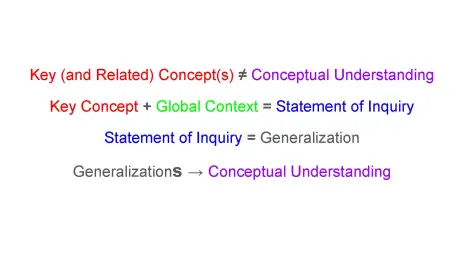
Lockdown 3.0: As we start our second period of full remote learning (please, God, let this be the last!), I am reflecting more and more on the value of concept-based learning. And the conclusion I have come to is this: the IB curriculum framework (PYP, MYP or DP) does not guarantee conceptual understanding. For many years, I thought that, just by nature of the fact that I was teaching the IB, I was a concept-based teacher. I couldn't have been more wrong. Because even if the written curriculum is concept-based, that does not mean that the pedagogy is. A well-intentioned 3-Dimensional curriculum can too easily fall back into a 2-Dimensional mode of delivery. (This is probably especially true in a remote context, when often we are just trying to find activities to keep students busy.) And that has a further knock-on effect: if we aren't supporting the written curriculum with concept-based instruction, then how can we possibly assess students' conceptual understandings?
Conceptual teaching -- and conceptual learning -- is a mindset. It involves intellectual effort on our part to lead students on a journey to construct their own understandings. It's not enough to expect this conceptual learning to happen because it is written in the unit planner; we have to intentionally create opportunities for students to develop conceptual understandings. And if we are only focusing on the MYP statement of inquiry (which is often generic in nature) as our main vehicle for conceptual understanding, then we are not maximising opportunities to develop disciplinary depth and breadth of understanding.
To really get to the heart of the MYP (or DP) curriculum, we need to look at the philosophy(ies) that underpin it. I first stumbled upon Lynn Erickson's work when the MYP Next Chapter came out. As I read through the subject guides, I kept seeing her name pop up in reference lists. Who was she, I wondered, and why hadn't I heard about her? So I started my own inquiry and realised that this (Concept-Based Curriculum and Instruction) was where the real meat was, not the subject guides themselves. The subject guides merely lay out a framework. And if a framework is all you ever work with, using the concepts as afterthoughts but delivering the content in the same way as you always have, you aren't utilising CBCI to its full potential. If you are an IB teacher and you haven't already read the work of Erickson and Lois Lanning, you owe it to yourself and your students to do so. (The influential/inspirational work of Rachel French, Tiffanee Brown and Julie Stern has also informed and guided my exploration of concept-based pedagogy, and they are worth checking out.)
Even though I have been involved on many different levels with IB curriculum and assessment for 12 years, I am really in the beginning stages of my concept-based teaching journey. I plan to share more in the weeks and months to come, including resources I am developing for my classroom. I hate to think of all of the missed opportunities in my first decade of IB teaching, but I suppose I shouldn't dwell on negatives. As reflective practitioners, there is always the opportunity to deepen our own understanding and aim for better. It's never too late to amplify one's practice.