


I've been in professional development mode for a couple of weeks now. Over two days last week, I led 5 faculties at my school in a workshop on concept-based learning. Later this month, I will be delivering an MYP workshop for a school in the candidacy phase in Cyprus. I have to admit to being a little envious of them; despite the challenges of implementing a new programme or a new way of thinking, there are so many opportunities ahead of them and it can be an exciting time for a school -- and for the individual educator looking for the chance to reframe their teaching practice.
I've been reflecting on how my own views of PD have grown and evolved over the years. These reflections led me to pose the following questions:
What defines "professional development" (Factual)
How can individuals develop within systems? (Conceptual)
How can systems support individual development? (Conceptual)
I recently stumbled upon The PD Book: 7 Habits That Transform Professional Development by Elena Aguilar and Lori Cohen and their definition of PD affirmed the shift in my own understanding. According to them:
Professional development IS "a transformative process in which learners are actively engaged and for which the aim is to explore and expand behaviors, beliefs, and ways of being; a learning process that results in a change of practice." Professional developing ISN'T "a transactional process in which learners are passive subjects who are asked to simply change their behaviours." (Aguilar, 2022)
Unfortunately, a lot of school-based PD is transactional -- or it is outsourced to external providers. Many schools purport to offer "generous professional development opportunities" as a way to entice candidates, and whilst it is great if a school will pay to send you on a 3-day course to Barcelona or Budapest, these experiences are only effective if they are sustained post-event. And schools that don't have the means to fund these kinds of external activities can still be environments ripe for professional development.
Relying on approval for a PD event, rather than support for a PD goal, can be stifling. This kind of thinking can perhaps make teachers feel like they lack agency, consequently preventing them from taking part in activities that promote personal growth and progression. Some examples of professional development that are within an individual teacher's control and do not rely on the "approval" of the school (although they will be more successful with the support of the school) might include:
- Reading professional articles or books
- Engaging in a professional learning community (PLC). Since COVID forced a lot of professional development online, opportunities have arisen for global collaborations, making it possible to connect outside of your immediate school context.
- Peer observations or lesson studies
- Action research projects
- Unit planning and curriculum development
- Cross-disciplinary collaboration, including interdisciplinary teaching and learning
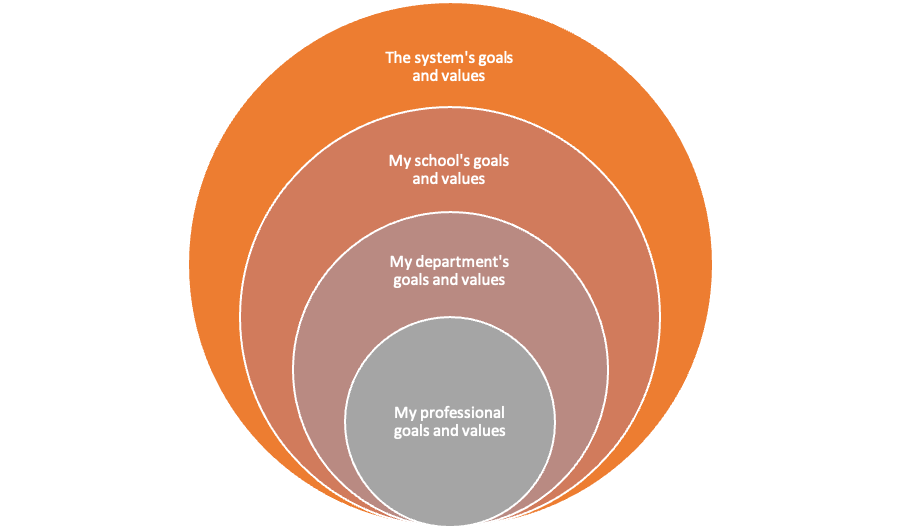
Whatever the activity, it is important to consider our individual goals (and values) within the context of the goals and values of the systems that we work in.
I used to think...
...that professional development was something that individuals went out and did or that organisations brought in. In other words, I saw it as something that was provided, rather than something that can be supported.
Now I think...
...professional development is much more nuanced than simply a course, a certification or a degree. Professional development is not an isolated event or a means to an end, but an ongoing process of inquiry, action and reflection.
I'll sign off this post with one last (debatable) question:
Is it the responsibility of individual educators or the systems they operate within to primarily drive and facilitate professional development?